Are you missing a tooth or two but confused about what options are available to you? Maybe this is causing you problems with eating or you cannot smile though embarrassment of the missing tooth, problem crown or bridge or loose denture teeth?
In the Youtube video below our resident implant dentist oral surgeon Dr Colin Neil BDS, MFDS RCS, MSc (Implant Dentistry) DipDentSedation, MSurgDent is interviewed by FindMeLocal TV and answers questions on how to find a dental implant oral surgeon that can help you:
Dental implants can help in so many ways and could be just the solution you are looking for. It may be that you currently have a denture which is not fitting correctly or you are looking for a more permanent solution? Implants can be used to stabilise dentures so your confidence can be restored.
Where it is indicated, we can provide same day, “teeth in a day” using the all-on-4 implant technique to replace all the teeth in the jaw using a fixed implant retained bridge. This revolutionary technique will mean that you can transition from entering our surgery with loose or missing teeth in the morning to leave in the afternoon with fixed implant teeth. This can be an incredible transformation for you and because we provide sedation if you wish, it can be carried out in a relaxed, comfortable atmosphere. Dr Colin Neil is a recognised expert in this technique which he has developed as his hugely successful and predictable “Fixed Teeth, Fast (™)” protocol.
 Dental implants can also be used to form the solid foundations to maintain your bone and provide fixed support for your new individual replacement teeth which can then be made to look, feel and function so that they imitate natural teeth as closely as possible. Dental implants can enhance your chewing function/efficiency, improve your appearance and restore your confidence when smiling, laughing and even kissing!
Confident Dental Care & Implant Centre offer an implant service which will be carried out here in the comfortable surroundings of our practice by our expert implant oral surgeon Dr Colin Neil (profile).
In some cases, the bone required for implant placement is already damaged or missing but this does not mean that implants are not possible. We have our own in-house cone beam CT scanner which enables accurate 3D diagnosis and planning and our expert implant oral surgeon is able to re-build your lost bone using bone grafting, sinus grafting and block grafting guided bone regeneration techniques with a variety or organic and or synthetic materials to enable implant placement to proceed.
Dr Colin Neil is a tutor and mentor for many implant training institutions and he provides implant referral services for dentists across the UK, both by referral for treatment in Stroud or via a mobile surgery service where dental implant equipment and treatment can be provided in your own dental surgery. For dentist referral, please contact reception or use the link below to obtain a referral form. Further information on implant mentor services for dentists can be found here.
If you would like more information on Dental Implants at Confident Dental Care & Implant Centre, please call us today on 01453 764287 for more information.
Further information on Dental Implants can be found at the following addresses:
http://www.adi.org.uk/ (Association of Dental Implantology)
http://www.astratechdental.co.uk/ (Astra Tech Dental Implants)
http://www.saad.org.uk/ (Society for the Advancment of Anaesthesia in Dentistry – sedation information).
What is a dental implant?
Almost all dental implants in use today are made from titanium or titanium alloy, materials that have been shown over many years to be well tolerated by bone.
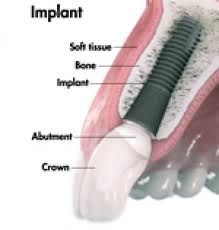
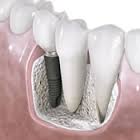

The terms ‘osseointegrated implants’ or ‘endosseous implants’ are widely used to describe dental implants that can develop and maintain a close union with bone in order to support replacement teeth.
There are many different implant systems available and when competently used they can all deliver a highly reliable form of treatment.
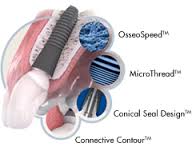
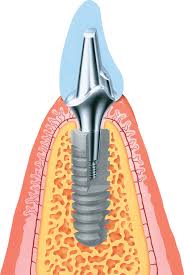
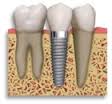
A dental implant is essentially a substitute for a natural root and commonly it is screw or cylinder shaped. Each implant is placed into a socket carefully prepared at the precise location of the intended tooth. If an implant has a screw-thread on its outer surface it can be screwed into position and if it does not, it is usually tapped into place.
Download a copy of the Association of Dental Implantology (ADI) UK’s (for whom Dr Colin Neil is an accredited mentor) ‘Consider the Implant Alternative’ leaflet here.
The main aim during installation of any implant is to achieve immediate close contact with the surrounding bone. This creates an initial stability, which over time is steadily enhanced by further growth of bone into microscopic roughnesses on the implant surface.
In order to support replacement teeth, dental implants normally have some form of internal screw thread or post space that allows a variety of components to be fitted. Once fitted, these components provide the foundation for long-term support of crowns, bridges or dentures.
For dentists who wish to refer one of their patients for implant dentistry, oral surgery, sedation or cone beam CT scanning services, please CLICK HERE
Dr Colin Neil is an accredited Clinical Coach trainer for AstraTech Dentsply dental implants and patients who are interested in implant treatment may choose to contact either directly through our Stroud practice details: Telephone our reception team Lesley, Sue or Rachel on 01453 764287 or email reception@confident-dental-care.co.uk or if patients prefer, you may also contact us through the Dentsply Implants website link: http://www.dentists4implants.com/implant_dentists/colin-neil_215
In addition to caring for patients of their own practice and those patients referred to us for implant dentistry, Dr Colin Neil and Confident Dental Care & Implant Centre provide training for other dentists interested in implant dentistry with regular training events held using our live-feed AV and seminar room facilities. Dentists please click this link for further information and to book your place on our next implant dentistry course: http://www.dentists4implants.com/implant_dentists/colin-neil_215_dentists
© Copyright 2021 Confident Dental & Implant Clinics